
Grow Your Business | Build Your Career | Develop Character | Find Meaning
In this essay (7 min. read):
What running a race in the desert can teach you about endurance
How the British special forces weed out recruits
Why building your dream may take your entire life

Either way, you’ll live through it.
When I was in high school, I ran cross country.
I started out as a hurdler, and I was remarkably bad at it. Turns out, leaping over hurdles kind of terrifies me, and I’m also not much of a sprinter.
So, I switched from hurdles to long-distance track. From there, I joined cross country.
On the Saturday of the first week of practice, we had to run 9 miles. I have no idea how long it took me. Something like 2 hrs. Before that Monday when I started practice, I’d never done more than 3 miles with my dad (on the same trail, ironically).
It was brutal, but somehow, 6 days after my official debut as a long-distance runner, I did it.
There were a lot of other moments that stand out to me.
Once, my coach had the varsity team run 6 miles from our normal practice location to the race. His rationale was that the race didn’t matter for our rankings, so it was a good chance to practice endurance.
Most of them finished the 3 mile race in the top 10 or 20 runners. At this point, they looked dead tired. I’ll never forget the look on their faces when our coach asked them to run the 6 miles back.
His point: your tank isn’t empty yet. You could have run harder.
I was grateful not to be on the varsity squad.
But, I had my moments like that too.
When I was a sophomore, the most difficult race of the year was Mt. San Antonio College, out in the desert near Pomona, California. Otherwise known as the infamous Mt. SAC race.
3 miles of a totally dirt track. No shade. No grass.
Not nice, packed dirt on an old-school track. Loose dirt on miles of hills, ready to be kicked up into thick brown clouds by the swaths of runners.
Plus, it was over 100 degrees Fahrenheit. 37 degrees Celsius for all the folks overseas.
To prepare, our coach had us run 12 miles of hill repeats. 12 half-mile sprints uphill. 12 half-mile jogs downhill. Start as soon as you get back to the starting line.
It was tough, but in the end, we survived. What was once a long day I dreaded for weeks is now a distant memory from 16 or 17 years ago.
I think that’s true for most of life.
Today’s challenges will either be a faded memory or just a story you tell one day.
Either way, you’ll live through it.
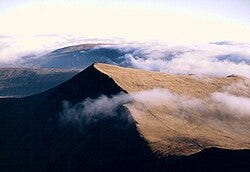
Are you relying on strength or heart?
A more extreme example of this comes from Bear Grylls. If you’re not familiar with him, he became famous doing a number of survival TV shows, where he’d demonstrate survival skills for how to live through difficult situations in the wilderness.
Prior to this, he became famous for hiking Mt. Everest 18 months after breaking his back parachuting, because his chute failed to deploy.
But his first big accomplishment was joining the British Special Air Services, otherwise known as the SAS, widely considered to be one of the top tier military units in the world. They’re known for their grueling mental and physical challenges, in addition to their single-digit pass rate.
At age 19, Edward Michael “Bear” Grylls failed on his first attempt.
Later that year, he tried again and passed.
He tells the story of the final challenge during his 2nd four-month trial period.
In true special forces fashion, candidates were required to march 40 miles through the Breton Beacons mountain range in Wales, without knowing exactly how long the march would be or how much time they had left to complete the 24 hr. challenge.
All this while carrying a 55 lb. rucksack, a rifle, and water.
A common trick used by the instructors was to remove hope and see how the trainees would respond.
Bear describes reaching the end of the march, where he and his teammates saw trucks waiting to pick them up.
As they walked closer, the trucks drove away. They were told to turn around and march back.
Some men quit right on the spot.
Imagine making it through 4 months of brutal training only to quit on the last day. He says the only reason he made it through is because an older recruit simply tightened up the straps on his backpack and started walking.
Not knowing what to do, Bear simply followed suit.
To this day, he says that the main requirement for succeeding in the SAS isn’t strength.
It’s heart.

The path is much longer than you realize.
Resilience in a difficult moment is one thing. Staying the course for two decades is another.
I was listening to a podcast recently with one of my favorite entrepreneurs, David Hieatt, founder of Howie’s, Hiut Denim and The DO Lectures.
His path as an entrepreneur has been a lifelong journey.
When he was 14, he was obsessed with sports brands and began pitching marketing ideas to sportswear companies. Not knowing he was only 14, they’d actually let him come pitch.
When he graduated high school, he delayed college by a year to become an entrepreneur. His dad loaned him 500 British pounds, half of his savings. Unfortunately, David went bankrupt in 6 months.
After David failed, his dad asked him what he learned. David said “I like building a business.”
Rather than harshly judge him for losing the money, his dad replied, “Ok, your next goal is to figure out how to make enough money to keep it going.”
When David finally went to college to learn about marketing, he got kicked out at the age of 19 for having too much fun.
He lived on government welfare for a year and drifted around until he somehow at age 21, landed a copywriting job at Saatchi and Saatchi, one of Britain’s premier ad agencies.
While working as a copywriter, he started a clothing company called Howie’s with his wife. It didn’t make a profit for 6 years. He kept it going on his copywriter salary.
But, eventually the brand became sought after by larger brands, even ones like Gucci. Eventually, he sold it to Timberland for over 3 million pounds.
Despite this success, David felt like he’d quit early. He hadn’t seen a company from beginning to end. So he started over.
In his hometown of Cardigan, Wales, there had been a denim factory. For 40 years, this factory produced 35,000 pairs a week. Most of the town’s residents were employed there, so when it shut down, everyone was suddenly out of work.
David decided to help out. He founded Hiut Denim and rehired many of the old factory workers. Over the next 17 years, he built the company into a premium denim company, making far fewer pairs of jeans, but making them for customers such as the UK’s royal family.
All throughout this time, he had a little side project called The DO Lectures, described as an “encouragement network for entrepreneurs.” It’s an eclectic mix of homely TED talks at a barn in Wales, online courses, in-person retreats, book publishing, and even an old school 24 hr. radio broadcast.
But he couldn’t go all in on it until just this year. He had to keep it small while running the denim company as his main project.
Sometimes creating magic takes a few decades.
Most of us are told to dream bigger, but David said something counterintuitive I’ve been thinking about a lot:
“Sometimes you have to keep your dream small enough to keep it alive for 17 years before you can go all in on it.”
Keeping your dream small is better than quitting.

Overnight success isn’t real.
My friend David McIlRoy recently said, “Many people quit because they didn’t live up to an invisible timeline they had in their head.”
We often want overnight success, and when it doesn’t happen, we get discouraged and quit. Growing a business, becoming a writer, or doing any kind of creative pursuit is daunting because it’s a lifelong game.
Some people quit because it’s hard. But more than that, I think people quit because there’s no end in sight.
It’s not that you have to do a 40 mile march. It’s that the trucks drove away, and you’re not sure how much longer you’ll need to keep walking. Or, on a smaller scale, your coach just told you to run 6 miles home after running a 3 mile race.
I have to remind myself sometimes, the timeline is a lot longer than I think. As the saying goes, every overnight success is 10 years in the making.
It’s not a matter of wondering whether the trucks will drive away. Just assume they will. Life almost never goes according to plan.
Don’t quit.
Want to read more like this?
Here’s a few of my favorites:
To learn more and see my essay archive, visit my Start Here page.
Image Sources:
Mt. SAC. Photo Credit: Kevin Wong. Creative Commons.

Breton Beacon Mountains. Photo Credit: Adrian Pingstone, Public Domain.

Cardigan, Wales. Photo Credit: Michael Garlick, Creative Commons.

You are a natural writer. I can feel you heart through your words.
My man, you could be writing for Nike with this absolute banger of an article. Well done! 👏👏👏